0
Monthly Archives

February 2026

Looking for Digital Health Experts?

By Blog posts

Last week, a CEO of a large pharmaceutical company called me.

He said, “We’re launching a Digital Health SBU. A serious one, not a side project. But we have a problem… we can’t find people who actually understand digital health.”

Then he added something honest — and worrying: “We are interviewing impressive people. They speak well. They’ve read a lot. But we are not confident they can build this.”

That conversation stayed with me.

Because Digital Health is the first domain in healthcare where reading about it and building it are worlds apart.

Article content

Healthcare historically hired specialists:

Doctors treated patients. Engineers built systems. Managers ran operations. But Digital Health sits at the intersection of all three – plus data, regulation, behavioural science, economics, and AI. So organisations unknowingly make a costly mistake.

They hire intelligent professionals with exposure to digital health, not formal training in digital health.

And then what happens?

You don’t just pay a salary. You pay for their learning curve. You pay when the strategy changes every quarter. You pay when products are redesigned.

You pay when clinicians resist adoption. You pay when regulators question architecture.

You pay when competitors move faster. You lose not because they are incapable, but because they are learning while leading.

When you hire readers instead of trained professionals, you have to pay higher compensation.

You pay the training cost on the job. You lose a competitive advantage while they figure it out

Digital transformation is unforgiving to organisations that learn slowly.

This is precisely why the Academy of Digital Health Sciences was created.

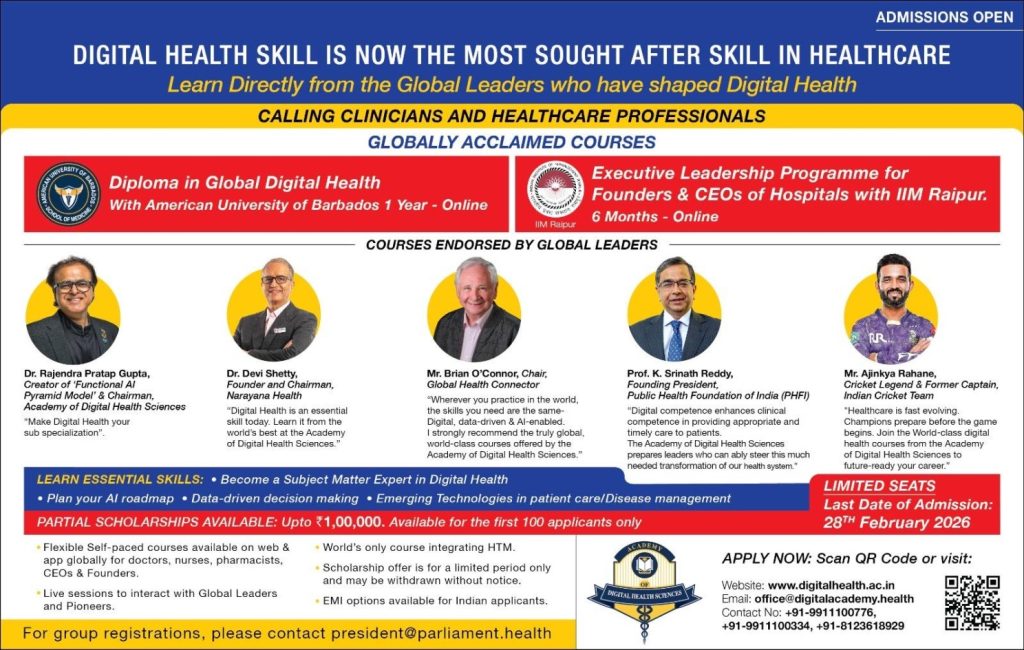
Nearly 700 leaders across pharma, hospitals, governments, insurers, and startups have now been formally trained by global pioneers who built the domain, not those who observed it.

And the difference is visible immediately: They don’t ask, “Which app should we build?” They ask, “What care model are we redesigning?” They don’t implement technology. They implement systems. They don’t experiment with AI. They operationalise it.

So if you are building a Digital Health department, SBU, or company, hire trained professionals and save time, resources, and strategic momentum.

We at the Academy of Digital Health Sciences offer a free service to share your job requirements with over 700 trained digital health leaders. Make the best use of this opportunity.

The Academy is here to help you lead in the age of AI. Write to: jobs@digitalhealth.ac.in, and we will get you the world’s best trained leaders in Digital Health 

Dr. Rajendra Pratap Gupta, PhD

Chairman

Academy of Digital Health Sciences

#DigitalHealth #AIinHealthcare #HealthcareLeadership #HealthTech #FutureOfHealthcare #hiring #jobs #AIjobs #hiring #aicareers #futureofwork #futureofhealth #aidriven
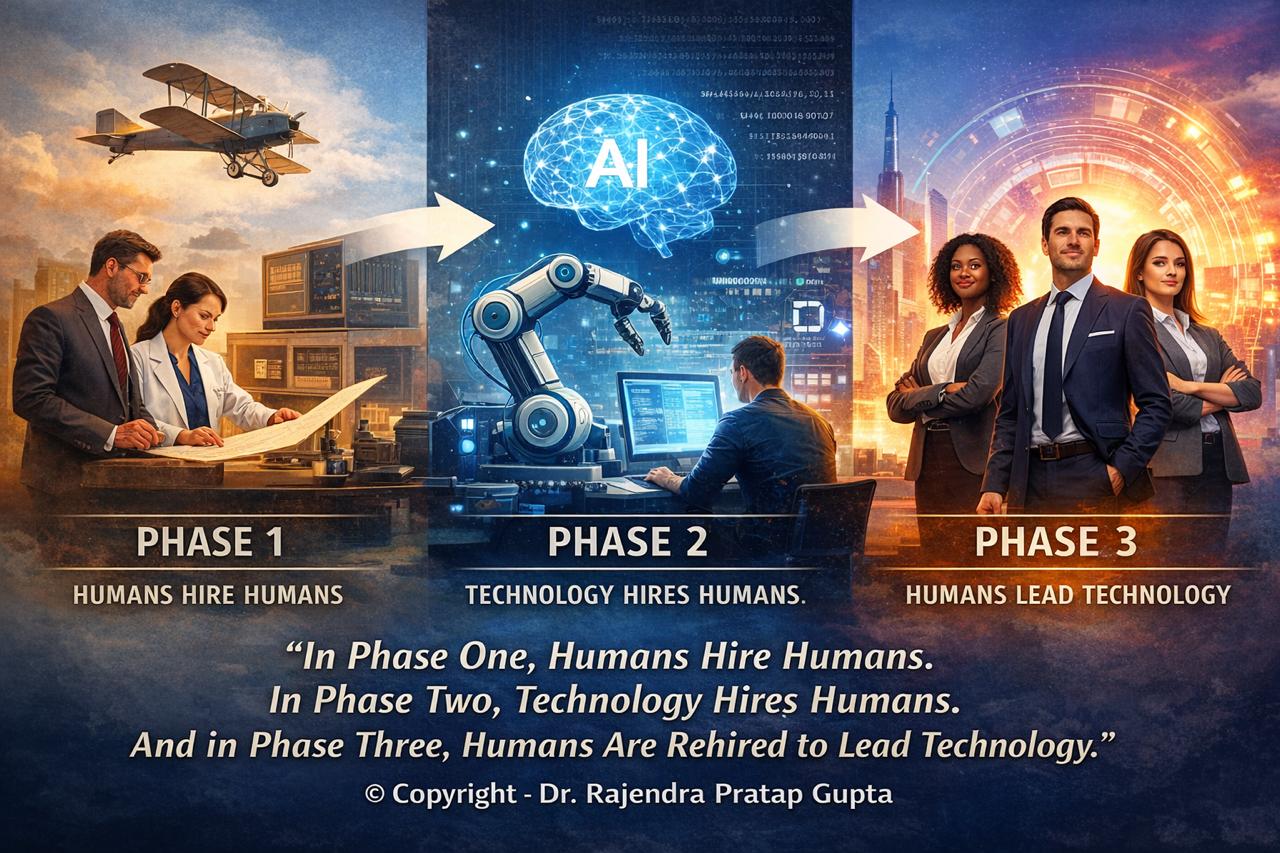
In Phase One, humans hire humans. In Phase Two, technology hires humans. In Phase Three………

By Blog posts

Every transformative technology begins with a familiar paradox: at the moment of its creation, humans become extraordinarily expensive.

In the early days of aviation, pilots were heroes and engineers were magicians. Flying demanded intense human skill, judgment, and courage. Technology was fragile; humans were invaluable. The same was true of early computing, when programmers were mathematicians and machines occupied entire rooms. Human intelligence was the bottleneck, so humans commanded premium value.

This is Phase One of every technology cycle: humans are expensive because technology cannot exist without them.

Then comes the inevitable shift.

Technology begins to create technology.

Tools improve, abstractions emerge, and complexity gets hidden behind interfaces. What once required a team of experts can now be done by one person, and soon, by a system. Efficiency scales. Costs fall. And gradually, humans who once defined value begin to look interchangeable.

This is Phase Two, the most unsettling phase-where humans appear cheap. Jobs are automated, skills are commoditized, and experience depreciates faster than ever before. We are living through this phase right now with AI. It is not a failure of people; it is a feature of maturing technology- thanks to humans !

The Human Returns!

But history shows us that the story does not end with replacement. It ends with rehiring.

When technology reaches a certain level of maturity, it discovers its own limitations. Machines optimize brilliantly, but they do not imagine. They execute flawlessly, but they do not judge consequences. They predict patterns, but they do not understand purpose. Fully autonomous systems eventually run into risks—ethical blind spots, contextual failures, and misaligned incentives.

That is when humans return- by design.

This is Phase Three: the return of the Human-in-the-Loop.

“In Phase One, humans hire humans. In Phase Two, technology hires humans. And in Phase Three, humans are rehired to lead technology.” But not all humans return equally.

The first to be rehired, and the last to be fired, are not those who merely operate technology. They are the creators, the innovators, and the leaders whose imagination moves faster than technology itself. These are people who don’t ask, What can this tool do? but What should we do with it? They see around corners, connect disciplines, and make decisions when data runs out.

Technology never replaces imagination. It amplifies it.

That is why the future belongs to leaders who can think beyond tools, understand systems, and translate technology into real-world value. In every cycle—from aviation to medicine to AI; the winners are not the best users of technology, but the best thinkers about technology.

This is exactly the gap we are addressing through our work at the Academy of Digital Health Sciences.

Our focus is not just on teaching digital tools, but on building digital leaders—professionals who understand how technology reshapes healthcare, policy, organizations, and society. Leaders who can sit confidently in the Human-in-the-Loop role, guiding systems with insight, ethics, and imagination.

Because when the cycle completes, and it always does- the question is not whether humans will be back in the loop.

The real question is: will you be one of the humans technology chooses to rehire?

Dr. Rajendra Pratap Gupta, PhD
Academy of Digital Health Sciences

#humancentredAI #AI #ArtificialIntelligence #digitalhealthLeaders #LeadersinTech #womenintech #techleaders #digitalhealthcourses #innovation #disruption #change #hospitals #abdm National Health Authority (NHA) Academy of Digital Health Sciences Health Parliament World Health Organization United Nations

Why Outstanding Thinking, not Pedigree -Is the Only Real Safety Net in the Age of AI

Why Outstanding Thinking, not Pedigree -Is the Only Real Safety Net in the Age of AI

By Blog posts

Earlier this week, I was on a call with the CEO of a large U.S.-based technology company. During the conversation, she mentioned, almost matter-of-fact, that she had enrolled in one of our programs. I was not surprised that she was learning; I was curious why.

When I asked her what prompted the decision, her response was direct: “My experience and degrees got me here. They won’t get me where I need to go next.”

That single line captures the reality senior executives across the world are beginning to confront.

We are living through a moment where artificial intelligence is not just transforming industries; it is rewriting the rules of relevance. For senior leaders, this shift brings an uncomfortable but necessary truth: prior experience, legacy titles, and even Ivy League qualifications are no longer reliable shields. They may open doors, but they no longer guarantee safety, longevity, or leadership in an AI-shaped world.

In earlier decades, linear careers worked. Expertise compounded slowly, industries evolved predictably, and experience acted as a moat. Today, AI has collapsed that timeline. A decade of experience can be neutralized by a single technological leap. A prestigious degree can be overtaken by someone who learns faster, adapts quicker, and thinks more originally.

What now separates those who stay ahead from those who quietly fall behind is not credentials-but outstanding thinking.

Outstanding thinkers are defined not by where they studied, but by how they learn. They build agile minds- minds sharpened by conversations, exposure, and continuous learning. They deliberately place themselves in rooms where ideas clash, where assumptions are challenged, and where future-shapers speak candidly about what is breaking and what is coming next.

Across sectors, this pattern is becoming unmistakable. Executives who were not “born digital” are now leading AI-enabled transformations because they invested in learning. Clinicians trained in a pre-digital era are shaping digital health strategy because they refused to freeze their education at graduation. Founders who did not invent the technology are redefining its impact because they mastered synthesis, judgment, and foresight.

AI does not reward those who know the most.

It rewards those who think best.

This is why learning from others who have already “made it big” matters deeply-not to replicate their journey, but to absorb their mental models. Senior leaders who regularly learn from builders, reformers, and disruptors gain perspective that no textbook or degree can provide. Perspective has become the new power skill.

In healthcare, the urgency is even greater. Clinical excellence without digital fluency is fragile. Business leadership without systems thinking is incomplete. Technology knowledge without ethics and public-health context is dangerous. The future belongs to leaders who can connect these dots, and that requires structured, lifelong learning.

This belief anchors the work of the Academy of Digital Health Sciences. We recognized early that healthcare professionals were being asked to lead in a future they were never trained for. Instead of incremental upskilling, we designed disruptive learning experiences-rooted in real-world practice, global exposure, and peer learning.

Nearly 700 clinicians, healthcare professionals, and business leaders have already benefited from these programs. Many came with decades of experience and impressive qualifications. What they sought was not another certificate—but an upgrade to their thinking.

One question senior executives often ask is: How much should I invest annually in my own future growth?

A practical benchmark is clear:

At least 1–3% of annual compensation, or
₹3–10 lakh per year, whichever is higher,
dedicated exclusively to high-quality learning programs that provide exposure, conversations with leaders, and frameworks for future decision-making. This is not a cost. It is professional insurance.

In the age of AI, staying “safe and alive” is no longer about what you achieved once. It is about how fast you can learn, how deeply you can think, and how willing you are to be challenged.

Outstanding thinking is the new credential.

Continuous learning is the new job security.

And those who invest in their minds today will be the ones trusted to lead tomorrow.

Dr. Rajendra Pratap Gupta, PhD
Chairman
Academy of Digital Health Sciences

#ArtificialIntelligence #LeadershipInTheAIera #ContinuousLearning #ExecutiveLeadership #FutureOfWork #DigitalHealth #HealthcareLeadership #LearningAgility #ThoughtLeadership #FutureReady

1 3 2 6 9 5 7